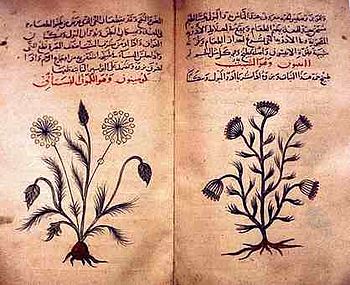
Arabic herbal medicine guidebook (Photo credit:
Wikipedia)
Using natural supplements to help treat MS is always a topic of much interest amongst patients. In the face of the sometimes daunting side effect profiles of the pharmaceutical drugs approved to combat the disease, the use of herbs and other natural substances, widely perceived as being more benign than the immunosuppressant/immunomodulating pharmaceutical products, holds great appeal for many dealing with Multiple Sclerosis. MS research headlines regularly trumpet one natural remedy or another as having been discovered to slay or at least tame the MS beast, and stories of miracle cures abound, percolating their way around the Internet. It can be awfully hard to separate the wheat from the chafe, so to speak, making the whole topic of herbal remedies a great big ball of confusion.
I’m very fortunate that the MS clinic at which I’m a patient, The International Multiple Sclerosis Management Practice here in New York City (
click here), has on staff a naturopathic doctor specializing in the treatment of neurologic illness. Dr. Deneb Bates is one of the sharpest physicians of any specialty that I’ve had the pleasure of working with during my experience as an MS patient, and with her guidance I take a variety of herbal remedies and concoctions designed to alleviate my symptoms as much is possible. I can’t say that the witch’s brew of natural substances that have become part of my daily routine has put the brakes on my disease progression, since my illness seems intent on defying any efforts to rein it in, but I hope they may have at least slowed my progression a bit, and I’m certain they’ve at the very least helped to dampen some of the symptoms of my condition.
Before I spill the beans (ha ha, just a little natural supplement humor) on the rather long list of supplements I take, let me first state that mine is a very atypical case of MS, if it is even MS at all. I’ve been poked and prodded by some of the world’s best MS specialists, and none has been able to come up with an absolutely definitive diagnosis for whatever it is that ails me. Clinically my disease presents like Primary Progressive Multiple Sclerosis (PPMS), but many of my test results leave physicians scratching their heads. In fact, after some disagreement, my neurologist and I have settled on calling my disease PPMS with the caveat that in my case those initials stand for the “Peculiar Paralysis of Marc Stecker”.
Additionally, I have several complicating factors that make me an especially difficult patient to treat. I have a wide array of endocrine problems, stemming from autoimmune thyroid disease and an increasingly faulty pituitary gland (also possibly due to autoimmune problems). My many hormone imbalances can result in symptoms that mimic those of neurologic illness, such as fatigue and muscle weakness, making it sometimes hard to figure out just what physical defect is causing which misery.
I also suffer from Avascular Necrosis (also called AVN), which is a very rare side effect of intravenous steroid use. AVN causes the bones in the major joints to perish, at which point they quite literally crumble and, as you might imagine, cause immense pain. I have AVN in both hips and both shoulders, which means that I’ve been living the last five or six years with the equivalent of two broken hips and two broken shoulders. To call the condition painful would be a gross understatement. If my overall health were better I’d have had both hips replaced years ago, but due to the ravages of MS and all of my hormonal deficiencies undergoing such major surgery would be extremely risky. Instead, I live each day gritting my teeth through pain that varies from uncomfortable to excruciating to, well, there really are no words for it, though at times long and creative strings of obscenities attempt to fit the bill. In order to try to keep my AVN pain down to a roar, I’m on very strong anti-inflammatory medications as well as the occasional opioid painkiller, all of which can cause problems of their own, such as liver and kidney toxicity.
Lastly, careful screening of my cerebral spinal fluid by my MS clinic’s on site laboratory has shown that I have extremely high levels of oxidative stress and extremely low levels of natural antioxidants in my central nervous system, the combination of which may be contributing to my ongoing neurodegeneration. Oxidative stress occurs as the result of the body burning nutrients to create energy, the process of which releases nasty little molecules called free radicals that can smash through cell walls and damage vital tissues and organs (
click here). Think of these free radicals as the body’s equivalent of the noxious exhaust fumes put out by an automobile engine when it burns gasoline. The human body is normally equipped with natural antioxidants that soak up many of these free radicals, but even in the healthiest people some antioxidant supplementation isn’t a bad idea. In my case, with my natural levels bizarrely low, it’s just about requisite that I try to boost these levels with antioxidant rich supplements.
As you’ll see, many of the natural supplements on my list are anti-inflammatories and/or antioxidants, which can be helpful to all MS patients (a major component of the MS disease profile is inflammation, after all) but are especially so in my case due to my problems with AVN and low levels of natural antioxidants. Some of the other items on my list are targeted at helping kidney and liver function, which can be compromised by many of the medications MS patients take to help control their symptoms. None of these supplements should be taken without first consulting your doctor. Don’t be fooled into thinking that anything thought of as “natural” is without the potential to do some harm. Indeed, some of these supplements are strong medicines, and can adversely interact with pharmaceutical meds, making it vitally important that their use not be embarked on as a do-it-yourself adventure.
Okay, with that rather long prelude out of the way (is it no wonder I shy away from twitter? I don’t think I could say hello in 140 characters) here is the list of natural supplements I take each and every day, in no particular order. I’m intentionally not including the dosages to discourage folks from simply taking these things willy-nilly, without first consulting a physician. Please don’t hate me…
Vitamin B Complex - Vitamin B comes in many forms, most of which play an important role in the function of the central nervous system and metabolic processes (
click here). In fact, people with severe vitamin B deficiencies are sometimes misdiagnosed as having Multiple Sclerosis. Since the most obvious symptom of my disease is a slow and steady decline of neurologic function, making sure my body is well stocked with Vitamin B just makes sense.
Green Tea Extract - as the name implies, this stuff is derived from green tea, which is tea in its unfermented form (unlike black tea). Green tea is among other things an extremely effective antioxidant, and has been shown to be helpful with cognitive functioning (
click here). You could likely get the same benefit from drinking 5 or 6 cups of green tea a day, but given my bladder frequency/urgency issues, if I were to go that route I’d have to spend the better part of my day in the bathroom, and might, in fact, never stop peeing. So, I choose to take the stuff in pill form instead.
Curcumin - curcumin is the active ingredient in tumeric, the spice which is the basis of curry powder. Curcumin is both a very strong anti-inflammatory and antioxidant (
click here), and is purported to have a very long list of health benefits. Interestingly, countries with a curry rich diet often have very low rates of autoimmune diseases, but of course other factors may come into play.
Milk Thistle - milk thistle is a flowering plant related to the daisy family, and is very effective in helping to maintain proper liver functioning (
click here). Since I take many medications that are metabolized in the liver, my liver function has always been of great concern to my physicians, and milk thistle has been effective in keeping my liver enzymes within the normal range ever since I started taking it. Before I started taking milk thistle, blood tests would often reveal my liver enzymes creeping above acceptable levels. So, milk thistle, good stuff.
Pellitory of the Wall (Parietaria) - what milk thistle does for the liver, this stuff does for the kidneys. Because of the problems in my hips and shoulders, I take a very powerful, prescription only nonsteroidal anti-inflammatory (NSAID) which helps keep the pain in my joints to manageable levels. Unfortunately, this drug can wreak havoc on the kidneys, and my pain management Dr. is always hyper concerned about checking my kidney function via blood tests. Before I started taking Pellitory of the Wall my kidney function tests would often veer into dangerous territory, but after consulting with my naturopath and starting on Parietaria my kidney function numbers have all fallen comfortably within normal ranges. My pain management doctor. was so shocked by this reversal in kidney function levels that he insisted on calling my naturopath to find out more about the stuff. Pellitory of the Wall has also been used traditionally to treat urinary tract infections, rheumatic elements, and some circulatory system problems (
click here). Again, good stuff.
Licorice Solid Extract - one of my endocrine problems is low levels of cortisol, one of the body’s natural steroids which is manufactured by the adrenal glands. Licorice is very effective in helping to maintain adrenal function (
click here), and taking it has in fact increased the level of cortisol circulating in my blood. Licorice solid extract is a concentrated form of natural licorice and is very effective in helping to deal with fatigue, which is a well-known and very problematic MS symptom. This stuff isn’t to be fooled around with, though, as it can raise blood pressure and heart rate, in some people to dangerous levels. Be aware that most licorice candy has little if any real licorice in it at all, so eating lots of Twizzlers won’t have the same effect.
Eleuthero Solid Extract - although Eleuthero is sometimes referred to as Siberian Ginseng, this root is only a very distant cousin to the more common Asian and American ginsengs. In naturopathic terms, Eleuthero is considered an adaptogen (
click here), a substance used to keep the body in balance. Eleuthero is purported to help with stress-related conditions, colds and respiratory infections, immunologic functions, and fatigue, among other uses (
click here). I’m taking it because I have a long history of chronic sinus infections, as well as to try to counteract my usual host of endocrine problems. I’ve found that Eleuthero does seem to help with my MS and/or endocrine related fatigue.
N Acetyl Cysteine (NAC) - NAC is an amino acid that is a powerful antioxidant (
click here). The substance is a precursor to glutathione, which is the body’s own natural and most powerful antioxidant, used to combat all of those nasty free radicals that result from the body metabolizing food into energy. As I mentioned previously, tests of my cerebral spinal fluid have shown me to be severely deficient in natural antioxidants, so, in theory, I stand to benefit from as much antioxidant support as I can get. NAC is also known to have antibiotic and perhaps antiviral properties.
L-lysine - L-lysine is an “essential” amino acid that cannot be manufactured by the body. It’s considered very effective in helping with the symptoms of osteoarthritis and is supposed to have prominent antiviral properties (
click here). Many researchers believe that a virus or viruses play some role in the MS disease process. L-Lysine also plays an important role in the production of hormones, antibodies, and enzymes. The stuff additionally aids in the production of collagen, which is essential for the health of bones and skin, and it shows up in many skincare products.
Boswellia Extract - Boswellia is also known as frankincense, which, according to the Bible was one of the gifts the three wise men brought to the baby Jesus. Hey, if it’s good enough for the baby Jesus, it’s good enough for me. I’m hoping that if I take enough of it I may someday be able to walk on water, which would really be a miracle since I currently can’t even walk on solid ground. Boswellia is a powerful anti-inflammatory agent, and it also has anti-oxidative properties (
click here). Like some of the other natural supplements on this list, Boswellia has also been shown to have germ fighting properties. Inflammation, oxidative stress, germs, BAD. Boswellia, GOOD.
Vitamin D - by now, I’m sure most MS patients have heard of the importance of vitamin D in helping to potentially ward off the disease in those who don’t already have it and perhaps dampen its impact on those who do (
click here). Depending on the level of vitamin D in a patient’s blood, it’s pretty much generally agreed that most patients should be taking some amount of Vitamin D supplementation. Careful, though, as taking too much vitamin D can be toxic, so you don’t want to overdo it.
MitoQ - this supplement is basically a supercharged version of CoQ10, a very powerful antioxidant. MitoQ is specifically targeted at mitochondria, organelles that are known as the “powerhouse of the cell” which play a vital role in metabolic processes. Recently, some studies have shown MitoQ to be remarkably effective in treating the mouse model of MS (
click here). As with all MS research done on mice, the results of these studies should best be taken with a few grains of salt, since the mouse model of MS is an absolutely horrible stand-in for the human version of the disease. That said, MitoQ’s antioxidant properties alone make it a good option for someone like me who has been shown to be sorely lacking in natural antioxidant levels.
Magnesium Glycinate - repeated blood tests have shown me to have low levels of magnesium, a mineral which is important to the health of cells, nerves, muscles, bones, and the heart (
click here). Additionally, magnesium has laxative properties, which make it a good candidate for those of us suffering from the all too common MS pooping problems. Or, more correctly, lack of pooping problems.
Krill Oil - krill oil is a form of fish oil, made from shrimp like creatures called, you guessed it, krill. Like fish oil, krill oil is rich in omega-3 fatty acids, which have been shown to lower cholesterol and are also suspected to help ease MS symptoms (
click here). The major advantage that krill oil has over fish oil is that the stuff made from krill doesn’t lead to fishy tasting burps and an unpleasant aftertaste. One of my longtime mottos as always been “whenever possible, avoid fishy burps”, so krill oil helps keep me true to my credo.
Well, there you have it, 14 dietary supplements that are part of my daily routine. Please consult your physician before starting any of the above-mentioned supplements. Mother Nature can be a beautiful maiden, but one not without teeth.
Most MS patients probably don’t need to take nearly as many supplements as I do, but since I have problems compounding my problems, it’s my hope and belief that at least some of the supplements are contributing to making my life more livable. As I stated previously, in addition to my neurologic problems I also have all kinds of endocrine dysfunctions as well as crumbling bones in my hips and shoulders, so I can certainly use all the help I can get.
Yes, when it comes to MS, I hit the triple jackpot – my initials are MS, I have MS, and I am a mess. Thank you, universe…