Showing posts with label chronic illness. Show all posts

Friday, November 18, 2016

Why Must It Be So Damned Hard To Be Sick?

I’m fully aware that the concepts of “fair” and “unfair” are constructs of the human mind. Politely stated, stuff happens. We then process that stuff and sort it into any number of mental files, “fair” and “unfair” being but two of the many choices in the filing cabinets we all carry around in our heads. Yeah, it seems unfair that I got slammed with the MS stick, but so did 400,000 other people in the USA. It’s also unfair that I wasn’t born into British royalty, but, given my proclivity for drunken shenanigans, the royal family might think it unfair if I was. Then again, I’d probably fit right in…

That said, I do think it is unfair that people socked with chronic illness are forced to not only deal with the ramifications of their diagnosis but also with a medical infrastructure that often seems geared towards making being sick as difficult as possible. It’s as if having a terrible illness isn’t quite enough; most patients soon find that on top of their condition come layers of impediments that seem designed to make being infirm an exercise in frustration, aside and apart from the effects of the disease itself. Primary among the contributors to the difficulties encountered by the chronically ill are insurance companies, pharmaceutical companies, and the doctors who treat the illnesses themselves, an interlocking triumvirate that oftentimes seems intent on destroying the peace of mind of those unhappily forced into its grip. Let’s look at each of these elements individually, and explore the many fangs of this three-headed beast. 

First, we have the insurance companies, which are generally perceived as big, boring, faceless monoliths filled with human automatons making love to their spreadsheets and actuarial tables. The reality of the insurance industry is a bit different, though. Insurance companies are professional gamblers who look at the entire world as one big casino. By fastidiously crunching data accrued over centuries, insurance companies place bets tilted in their favor on almost every aspect of life, including life itself. 

In the case of the health insurers, the primary wager placed is that the money paid to them by the mostly healthy people they insure will far outweigh the money the company needs to pay out when the bet goes wrong and their customers get sick. Like any gambler, insurance companies hate to lose. When their wagers go south, they’ll shamelessly employ any number of unsavory tactics in an attempt to minimize their losses. For patients forced to deal with insurers who aren’t keen on making good their part of the wager, this means having to navigate intricate bureaucracies who play by rules largely of their own making, utilizing tactics designed to discourage and dismay those trying to get their fair due. 

Primary among these strategies is simply to delay making payments in the hopes that the patient will grow so incredibly frustrated they’ll eventually throw up their hands and give up. Insurers do this by putting as many obstacles in the way of the patient as possible, in the form of a labyrinthine paths to payment filled with large amounts of paperwork, endless requests for additional information, and a wall of bureaucracy meant to intimidate and appear impenetrable. Is there any less savory prospect than having to get on the phone with an insurance company representative to try to resolve a claim that the insurance company has arbitrarily denied? I’d rather try to brush my teeth with a flaming stick. 

In the nearly 15 years since my diagnosis, I’ve spent countless hours on the phone doing battle with insurance company demonoids intent on frustrating my every attempt at having them make good on their obligations. Requested paperwork, once delivered, is often mysteriously “lost in the system”, requiring it to be refiled all over again. Claims are passed from department to department in an apparently endless loop, with each department introducing a new set of rules and requirements. The phone reps themselves are not empowered enough to actually take any actions, meaning that most of what is said to them is simply wasted breath. Aargh! 

The key to getting eventual satisfaction (not to mention the money owed to you) is to never give up, even if it feels like your brain is about to blow through the top of your skull. In the words of Winston Churchill, "Never surrender!" If the phone rep is unable to give you a satisfactory answer, demand to speak to their supervisor. If that supervisor is uncooperative, demand to speak to their supervisor. Eventually, if it seems that you have run out of people to talk to, threaten the nuclear option: tell them you are going to get your state insurance regulators involved. This will usually lead to a miraculous resolution of your case. Unless of course you live in a state with lax insurance regulations, in which case you might try making hyena noises into the phone. 

Of course, one of the reasons the insurance companies are so loathe to make payments is the outrageous costs of medical procedures and pharmaceutical products. This brings us to the second member of our triumvirate of torture, the pharmaceutical companies. Contrary to popular belief, the pharmaceutical companies themselves are not inherently evil, they just smell that way. The first thing to keep in mind when thinking about the pharmaceutical industry is that pharmaceutical companies are not in business to produce cures. This may be difficult to grasp at first, but truer words were never spoken. Except maybe “never eat enchiladas after midnight”. The indigestion will kill you, and you've got enough problems. 

All of the major pharmaceutical companies are public companies, meaning that their stock is traded on the public stock exchanges. As officers in public companies, pharmaceutical executives are mandated by law to be beholden to their shareholders, not to the patients taking their drugs. The importance of this point cannot be overemphasized. Given this reality, a company making billions of dollars on a drug designed to treat a disease could potentially run afoul of their stockholders (and the law) if they came up with a drug that cured the goose that lays perpetual golden eggs. This is a classic conflict of interest. 

The tremendous profitability of "successful" pharmaceutical products has led Big Pharma to engage in many morally questionable activities. Believe it or not, more money is spent on marketing pharmaceuticals than is devoted towards the research and development of newer and presumably better drugs. Since the pharmaceutical companies themselves fund most late stage medical research – they are the only entities with enough money to do so – negative research results are often suppressed and never see the light of day. This means that the research our doctors rely on when making treatment decisions is inevitably skewed towards the positive. Supposedly independent research has often been found to have actually been written by ghostwriters in the employ of Big Pharma. The pharmaceutical lobby is one of the most powerful in Washington, practically ensuring that most of these ills never get properly addressed by our lawmakers. 

Having said all of that, the most insidious and pernicious way the drug companies impact patients themselves is their ongoing practice of bribing doctors to prescribe their drugs. Naturally, these bribes are dressed up in all manner of tuxedos and ball gowns, taking the form of “honoraria” or “consulting fees”. Doctors are paid copious sums to “educate” their fellow physicians, most often over expensive dinners at fine restaurants. Physicians are invited to “educational symposiums” which take place at luxurious resorts where most of the education seems to come in the form of 18 holes on a golf course. In one of their latest ploys, pharmaceutical companies ask doctors to fill out surveys which earn the physicians points that can be redeemed for all sorts of luxury goods (click here). 

How and why are these practices not illegal? Got me. Before MS forced me to retire, I worked in the music industry for one of the largest multinational entertainment companies in the world. If our company was caught paying radio stations to play the records we produced, people would go to jail. Now, what is more harmful to society, music companies paying off DJs, or drug companies paying off physicians? 

Thankfully, patients now have a resource by which they can find out just how much money their doctors are taking from pharmaceutical companies. The website “Dollars for Docs” makes it easy for patients to look up their doctors and find out exactly how much pharmaceutical company money their doctors pocketed from August 2013 to December 2014 (click here). I’m happy to say that my neurologist doesn’t even allow pharmaceutical company representatives into his clinic, and the fact that he doesn’t appear on the Dollars for Docs database confirms this. If your doctor does show up on the database and has pocketed tens of thousands of dollars of pharmaceutical company largess, it’s certainly within your rights to question them as to how these payments influence their treatment decisions.

Which leads us to the final element in our trilogy of torment, which, tragically, is often our physicians themselves. This is by far the most heartbreaking component of the obstacle path patients with chronic illness must navigate, as our doctors should be sources of comfort and care, not necessary evils. I consider myself extremely fortunate to have as my neurologist a man I not only respect but for whom I also have a very real affection. And I’ve every reason to think that the feelings are mutual. Sadly, in my contacts with literally hundreds of MS patients since I started this blog, I’ve found that the clear majority have a negative relationship with their neurologists, with feelings ranging from mild apprehension to utter disdain. 

As patients saddled with chronic illnesses, we are forced to enter long-term relationships with the doctors we choose to treat our conditions. As with any long-term relationship, it’s important to choose a partner who will be a positive in your life. And yes, I did say partner. The patient-doctor relationship should be a partnership, not a dictatorship. The patient should be respected and educated by their doctor, not talked down to or given orders without any explanation. 

Oversized egos seem to be abundant in those who don white coats and endeavor to be healers, and I suppose a certain amount of ego is only to be expected given the often daunting professional path taken by those who choose to treat intractable illnesses. But, contrary to what many of them seem to believe, doctors are not gods, and the fact is, just as in any profession, there are those who are great at their jobs and others, not so much. There’s an old joke that asks “What do you call someone who graduates from medical school with a C- average?”. The answer: “A doctor”. 

For patients with serious illnesses, it’s easy to feel at the mercy of the person we desperately hope will relieve the burden of our disease. Sadly, I’ve heard far too many stories of supposed MS experts giving patients horrible advice, putting them on treatments clearly wrong for that particular patient, or leaving the patient themselves to make serious treatment decisions while providing little or no pertinent information upon which to base those decisions. 

My first MS neurologist, the man who gave me my diagnosis, was I am sure a brilliant human being, highly respected in his field. Unfortunately, he had the bedside manner of The Great Wall of China, without the scenic views. I was shocked when at the end of our first appointment he handed me four videotapes – each promoting a different MS drug – and told me to go home, watch them, and come back with a decision as to which drug I wanted to try. I was so confused I could barely get a word out. At that point I had barely wrapped my mind around the fact I was seriously ill and knew absolutely zilch about Multiple Sclerosis. I was overwhelmed, frightened, and certainly in no position to pick a drug based on some slickly produced video presentations. Needless to say, this neurologist did not stay my neurologist for long. 

I do realize that in many parts of the country and the world MS specialists are hard to come by, so many patients have a limited choice of doctors. Even in these situations, though, it’s important to make sure that your questions get answered, that your fears and concerns are addressed, and that you are seen as a human being, not merely a body harboring a dread disease. Always remember this: your doctor works for you, not you for them. Just like anybody else you pay for service, your doctor is under your employ, not the other way around. As your doctor’s employer, you are free to fire them if you are not satisfied with the job they are doing. Now, that doesn’t give you the right to be disrespectful, impolite, or tyrannical, and even under the care of a top-notch physician dealing with MS can be a messy affair, both emotionally and physically. You owe it to yourself, though, to become an active participant in your treatment plan, and that means partnering with a doctor you can trust and respect, and whose motivations aren’t subject to suspicions of self-interest. If your current doctor fails to meet those criteria, I suggest you start looking for a new one. 

In short, being sick sucks. Not only do we have to deal with the ravages of disease itself, but also with all sorts of ancillary BS that makes life for those unfortunate enough to be stricken with chronic illness exponentially harder. Between the insurance companies, pharmaceutical companies, and some physicians, the impediments faced by those with serious illnesses can be almost impossible to confront. And yet confront them we do, with a quiet heroism that goes almost completely unacknowledged. 

The myriad obstacles thrown at people with serious illness are by and large beyond the comprehension of the healthy, as one cannot fully understand just how dysfunctional the modern medical establishment is until one is thrust into the belly of the beast.. We who are members of a club that none of us wanted to join share insights and experiences that are ours uniquely. As WC Fields famously said, all in all I’d rather be in Philadelphia…     


For those readers who might enjoy an MS essay of a more philosophical bent, my friend Mitch, who maintains the MS blog Enjoying The Ride, wrote a wonderful piece on acceptance in the face of ongoing disease progression (click here).     


RIP Leonard Cohen, who died last week at age 82. One of my favorite songwriters, I think he’s pretty much the man I always wanted to be. Though this isn't one of my most cherished of his compositions, this song is quite apropos for the times in which we now find ourselves…  


Tuesday, August 26, 2014

The Problem with Progression, Revisited

English: Cropped version of :Image:Domino effe...

English: Cropped version of :Image:Domino effect.jpg (Photo credit: Wikipedia)

The good folks who administer the website MultipleSclerosis.net (click here) and I have reached an agreement to publish 20 essays from the Wheelchair Kamikaze archives on their site. MS.net is a wonderful resource for MS patients and those who love them, filled with the latest MS news as well as insightful articles and essays by folks dealing with the disease in all its forms. Lots of good stuff there, all of it high-quality. Best as I can figure, the fact that they decided to include some of my essays must be due to some sort of clerical error.

The initial WK essay published on MultipleSclerosis.net is a post that first appeared on this blog in July, 2009, entitled “The Problem with Progression” (click here). Back then I’d only been writing Wheelchair Kamikaze for about six months, and had been in a wheelchair for one full year. At the risk of stating the obvious, the essay deals with the progressive nature of Multiple Sclerosis disability. In it, I state that “the problem with progressive neurologic diseases is that they progress”, a sentiment which may seem self-evident but carries quite a wallop. When I was first diagnosed I listened in a befuddled haze as the doctor talked about the need to try to minimize something he kept referring to as disease progression. I’d no idea what he was talking about, but I sure would find out in the months and years to come.

Even in those early days it was clear I had progressive neurologic disease, with few if any viable treatment options available. Since then, new disease modifying therapies and even some alternative approaches have proven to have significant positive impact on many afflicted with the relapsing remitting form of MS, but though the attention of researchers is finally shifting to progressive disease there remains precious little in the way of effective therapies for us “progressives”.

The roughly 6 years between my initial diagnosis and my writing “The Problem with Progression” had seen the disease wreak havoc with my life. I’d gone from having a slight intermittent limp to requiring first an ankle brace, then a cane, and finally an electric wheelchair. I’d been busily employed in a high profile industry but was now 2 ½ years into my forced retirement, had seen my social life diminish from flame to flicker, had witnessed my body betray me in ways I’d never thought possible. Such a tremendous amount of upheaval in such a relatively short amount of time, my body caught tight in the grip of a seemingly insatiable beast, my mind buffeted by an emotional whirlwind, my intellect left to desperately try to sort it all out.

Given the alarming rapidity of my disease progression, I wrote about the difficulty of processing the losses already visited when the prospect of losses to come loomed ominously on the horizon. The flipside of looking back to mourn the wounds already inflicted is looking forward and anticipating the insults yet wrought, leaving little room in which to find some measure of solace.

The opening paragraph of “The Problem with Progression” talks about the realization that I’d very likely soon need to use my wheelchair inside my apartment, when at the time the mechanical monster had been used exclusively out-of-doors. Well, that little prediction did indeed soon come to pass, and now the notion of my walking from the bedroom to the living room seems about as likely as my being elected Pope (quite the long shot for a Jewish guy from Queens).

Later in the essay I talked about how annual events had become markers of my disease progression, times when I could look back one year and assess the damage done over the previous 12 months. I used the example of the Super Bowl, wondering if and when I’d no longer be able to watch it from the comfort of my living room couch, or even be able to manipulate the TV remote. It’s now been at least four Super Bowls since I’ve watched the NFL championship game – or anything else, for that matter – from that couch. Instead, all of my TV viewing these last few years has been done from the vantage point of my wheelchair, which is at once both a constant reminder of my imprisonment by the demented captor that is MS, and the key that keeps me from being completely swallowed up by the dungeon of disease.

The six years that preceded my writing “The Problem with Progression” witnessed MS completely reshape my existence in dramatic fashion. The five years since, though, have seen the changes become much more incremental, but in some ways perhaps even more insidious. The psychological hurdles presented by being forced by the disease to totally change almost every aspect of my day-to-day existence in the half-dozen years following my initial diagnosis were big-ticket items, readily identifiable monoliths with which to emotionally grapple.

Now, although the disease continues to progress largely unabated, the changes are more discrete, much less apparent to anyone but me and my closest observers – increasingly clumsy fine motor skills in my one still usable hand, a sometimes crushing fatigue, muscle spasms that pound away in the dead of night. Most of the blatantly obvious milestones have already been reached, but each passing year finds me still weaker and less able. Creative adaptations allow for a semblance of equilibrium in quality of life, but at some point, barring some much hoped for intervention, the mounting deficits will defy adaptation. The difference between the earlier, more obvious stages of my disease progression and that of these later years is kind of like being dragged under water. Once your head goes under the surface, all anybody looking from above sees is that you’ve submerged. The only one who can feel the increasing pressure and mounting darkness of being dragged deeper and deeper into the murky depths is you, the marvels of fresh air and sunlight drifting off as if they were only half remembered fragments of a long-ago dream.

It’s testament to the power of the human spirit that life beneath the waves still holds elements of wonder, sparks that continue to shine brightly once the effort is made to clear away the shade. Though the disease progresses so too does the desire to defy it, to stake a claim in a world turned upside down. I may not get out and about as much as I used to, even in the wheelchair, and the rigors and stresses of the disease – both physical and mental – may dictate submission to constraints I long to throw off, but I’m still here, dammit, occasionally licking my wounds but nowhere near willing to raise the white flag. Dragged under the sea of disability I seem to have managed to grow gills, and though I acknowledge and accept that there are depths below which there can be no survival I maintain hope that somehow, someway, I’ll break the grip of MS and once again bob to the surface. In the meantime I’ll simply do the best I can, even if this year’s best pales in comparison to that of only a few years ago. The problem with progression may indeed prove to be unsolvable, but it won’t be for lack of trying.

Monday, August 11, 2014

Man Bites Dog (or, MS Patient Beats Insurance Company after Stem Cell Transplant, to the Tune of $400,000)


(c) GoGraph / lhfgraphics
Oh, the many pleasures of Multiple Sclerosis. In addition to the physical and psychological toll taken by the disease, MSers also have to deal with a medical establishment that at times seems purposely set up to make being sick as hard as possible. Here in the USA, one of the most infuriating components of that medical establishment is quite often the private health insurance companies, upon whose whims many patients rely on to pay for such superfluous luxuries as vital medications, essential treatments, and indispensable mobility devices.

In my 11-year career as a patient with a progressive disabling disease I’ve been subject to an almost countless number of frightening medical procedures, the prospect of any one of which would have made the healthy me ruin my pants. Despite the horrid nature of some of these procedures – from needles in the spine to having tubes the size of fire hoses stuck into my veins to tests involving electric shocks of varying intensities – I’d have to say that the source of some of my most prolonged periods of agony have been long and drawn out battles with insurance company telephone tormentors who seem trained by the spirit of Marquis de Sade himself to extract as much psychic pain as possible while doing their god-awful best to avoid providing even the merest dribble of satisfaction.

Given my numerous nerve-racking experiences dealing with the insurademons, it was with great relish that I read the heroic man versus insurance company saga of Mr. Dave Bexfield, which was recounted in the August 3, 2014 edition of the New York Times (click here). I’ve been acquainted with Dave, at least in the virtual sense, for several years through our interactions on various Internet sites, forums, and email. We finally actually spoke to each other last week, as I was preparing this piece. Dave is the creator of the website ActiveMSers (click here), a vital resource for MS patients looking for inspiration and info on how to stay as physically active as possible. The site includes Dave’s blog, interactive forums, tips and tricks, and reviews of all kinds of gear designed to help people with MS stay in the game, so to speak.

Back in 2010 Dave underwent HSCT (hematopoietic stem cell transplant), a stem cell procedure that, in a nutshell, gives MS patients (or patients with a variety of other so-called autoimmune disorders) a new immune system by first destroying their old one through the use of powerful chemotherapy agents, and then resetting it via a stem cell transplant. For more info on the procedure, please refer to my last Wheelchair Kamikaze post, in which I wrote extensively about HSCT (click here). The treatment successfully put the brakes on Dave’s very aggressive relapsing remitting multiple sclerosis, but also left him $200,000 in the hole, a situation which precipitated an epic four-year Battle Royale with his insurance company.

In order to fully understand the majesty of Dave’s victory over his insurance company, I think a little background is in order. Back in 2005, Dave experienced his first MS symptoms, in the form of vision problems and strange sensory experiences. A few months later he suffered his first full-blown relapse, which resulted in the entire right side of his body going numb. After going through the usual diagnostic workup (MRIs, spinal fluid analysis, etc.) he received a verdict of MS. Over the next four years, despite being on the disease modifying therapies Copaxone, Rebif, and finally Tysabri, Dave’s disease slowly progressed, with intermittent relapses, until very suddenly a number of severe relapses put his MS progression into hyperdrive, leaving him at times barely able to take a step.

Just as he was reaching the point of desperation, Dave learned of an National Institutes of Health (NIH) sponsored HSCT study being conducted at the MD Anderson Cancer Center in Houston, Texas. He was accepted into the study, and was deemed the ideal candidate because of the very aggressive nature of his RRMS and his corresponding diagnostic test results. Unfortunately, after receiving this good news came some bad. Due to cuts in the federal budget, the National Institutes of Health, though still involved in the study, could no longer pay for the treatment. If Dave was to participate he would have to cover the entire $200,000 price tag himself. Yikes, to say the least. Dave lobbied his insurance company for financial assistance, but his pleas were rejected outright because of the experimental nature of HSCT treatment. Ultimately, Dave managed to cobble together the $200,000 by draining his savings and through the generosity of his immediate family.

Dave underwent HSCT in 2010, and though the treatment itself was no picnic, it did successfully slam the brakes on his multiple sclerosis, which had turned so aggressive that Dave believes the treatment saved his life. He’s had absolutely no relapses or further progression of his disease in the four years since undergoing HSCT. Of course, there’s no guarantee that his disease won’t mount a counteroffensive at some point in the future, a possibility which he acknowledges, but what MS patient wouldn’t gleefully accept at least a four year truce with their disease, during which the progression of their illness was stopped cold, free from drugs or any other form of treatment? You can read more about Dave’s HSCT experiences on his website (click here).

One might think that this would be the happy end of the story, albeit one with quite the hefty price tag. Just a few months after his stem cell treatment, though, Dave’s insurance company suddenly decided that it would indeed start paying for some forms of stem cell therapy for multiple sclerosis patients, though no such therapy had received any kind of official approval for this use. Dave contacted the company in an attempt to get reimbursed for his treatment expenditures, but was told that he was too late, and that the timing of his claim was simply “unfortunate”. Thus began a gargantuan four-year battle between Dave and his insurer, one which found Dave, with dogged (some might say maniacal) persistence, going to extreme measures to try to prove his case. Through the magic of Google he managed to uncover confidential files that directly contradicted much of what his insurance company was telling him – that they were merely following government mandated guidelines, and thus really had no choice in the matter – and Dave even went so far as to file a Freedom Of Information Act request to uncover yet more evidence of malfeasance on the part of his insurance company. You can read a more extensive, blow-by-blow account of the cage match between Dave and his insurance company on his website (click here).

During his four year struggle with the Insurazombies, Dave contacted a consumer advocate reporter at The New York Times, David Segel, who calls himself “The Haggler”. The Haggler lobbied the insurance company on Dave’s behalf, at first with no luck. Some months later, Dave then provided the Times reporter with some newly uncovered and extraordinarily damning evidence against the insurer, and The Haggler once again contacted the insurance company’s top executives, this time with proof that the company had lied not only to Dave but to the New York Times as well. As if by magic, a few days afterwards Dave found himself having lunch with both the President and the CEO of the $2 billion a year insurance company, during which they informed him that they had, by the good graces of the universe, suddenly experienced a change of heart; not only would they pay Dave the approximately $200,000 cost of the HSCT procedure (which, incidentally, is less than they would have spent on him by now for FDA approved MS medications if he were still taking them, which he certainly would have had he not undergone HSCT), but also the interest that the money would have accrued over the past four years, which came to just about another $200,000! Yes, the end result of Dave’s single-minded crusade to get his due was a check in the whopping amount of slightly over $400,000. Score one (or 400,000) for the good guy…

This David Bexfield versus Goliath story is an extreme example of the trials and tribulations many patients with chronic diseases face when trying to deal with their insurance companies. The problem boils down to a basic conflict of interest: though the insured are the insurance companies’ customers, they are also the determining factor in how much revenue these companies ultimately generate, even if they operate as nonprofit organizations. The less money an insurance company has to pay out to its customers, the better its bottom line. In a world where the profit motive trumps all else, this dynamic can set up some dicey situations for sick people trying to get the best health care possible, and even for those just trying to get the basic necessities required to live with their disease.

My own experience with health insurers has been almost schizophrenic. At times these companies have been incredibly cooperative, yet on many other occasions they seemingly took their tactics directly from the handbook of the Spanish Inquisition, making the prospect of dealing with their telephone representatives as appealing as an invitation to a potluck dinner at Hannibal Lector’s place. I can identify no rhyme or reason behind these vacillations in the behavior of insurance companies. In fact, many times they seem counterintuitive.

For example, this past fall, my insurer unhesitatingly approved my being treated with a rarely used and extraordinarily expensive drug, to the tune of $150,000 (the treatment turned out to be an absolute disaster, which you can read about by clicking here). Yet, only a few months before, this very same company had me alternately begging, screaming, whining, wailing, bellowing, whimpering, and very nearly bursting several very important blood vessels while trying to get approval for a new wheelchair, without which I would have had to change the name of this blog to Bed Kamikaze. The twisted and convoluted course of my six-month struggle to get a piece of gear that was an absolute necessity at times had me questioning my own sanity as well as the very notion of a just universe, and whether or not I might somehow have been drafted into the dyspeptic nightmares of a sadistic surrealist who had eaten one too many enchiladas right before bedtime.

My wheelchair saga played out over an innumerable number of phone calls, and it often seemed as if the Insurafiends were inventing new tactics and excuses even as I was talking to them. My wheelchair provider was “out of network”. Yes, but I had out of network coverage and was willing to pay the portion not covered by my insurer. Paperwork faxed to the insurance company mysteriously disappeared in the Bermuda triangle that apparently existed between my wheelchair vendor’s fax machine and theirs, and when by some miracle it was finally received on their end (with confirmation), it was inevitably lost “in the system” or found to be lacking some key bit of information or arcane equipment code, thus requiring the process to begin all over again.

Once the paperwork was in order, the Insuraschmucks suddenly decided that the specifications of the chair I had chosen were outside of acceptable parameters, and so couldn’t be covered. Mind you, it was the exact same model of chair I’d been using for the past five and half years, only with some added functionality made necessary by the increased level of disability I had accrued through the intervening years. I was told I could appeal the decision to some higher level of Insurabastards, which of course I did. After violating their own self-imposed deadlines for decision-making several times, the senior Insurapricks deemed that, yes indeed, my chosen chariot would be covered thanks to my physical decrepitude, as vouched for by my neurologist. And then came the folly of all follies; the Insurascum insisted that they couldn’t reveal how much money they’d reimburse until the chair was actually ordered, but how could I place an order for the chair until I knew whether I’d be on the hook for $1000 or $20,000? Arghhh…

In the years since my diagnosis, I’ve learned that all of the convoluted tactics employed by the health insurance companies to keep from paying legitimate claims can be boiled down to three words: delay, delay, delay. Their goal is quite simply to wage a war of attrition, frustrating the claimant with technobabble, feigned incompetence, and arbitrary rules and regulations until the sick person gives up due to frustration, physical and mental exhaustion, or the mistaken belief that they are somehow in the wrong. The insurance companies have nothing to lose by playing these games; the longer they hold onto your money the more interest they earn on it, and in fact many if not most claimants do eventually wave the white flag after months or years of interminable mindbending insurabullshit.

All of this corporate hornswaggle would be bad enough if it were employed only on the hale and hearty. However, the hale and hearty aren’t typically the ones filing claims with their health insurance companies. During the trench warfare in which I was forced to engage in order to get a new wheelchair, in times of desperation I would remind the Insurabeasts on the other end of the line that they were talking to somebody who was just about three quarters completely crippled. And that this cripple was only trying to get himself a new wheelchair, which due to my progressing crippledness had become an vital requirement. It wasn’t as if I was trying to get them to pay for a spa vacation in Shangri-La. No matter, rules are rules, even when they are invented, bent, and broken by the very people spouting them.

So, three cheers for Dave Bexfield, the man who managed to topple Goliath while also landing a solid right hook on the chin of his disease. Give thought, though, to those poor souls who through no fault of their own don’t have any health insurance, and are left to somehow fend for themselves in the world of the Multiple Sclerosis Industry and its hyper inflated prices. I’m sure those in countries outside of the US, who don’t have to deal with private insurers, have their own horror stories and headaches, both literally and figuratively. There just seems to be something sadly broken in a world where sick people have to actively fight not only to try to get better, but often just to maintain their sickly status quo. Good grief…

Saturday, December 7, 2013

How Are You?

English: "Three Gentlemen Greeting Each O...

English: "Three Gentlemen Greeting Each Other" (Photo credit: Wikipedia)
How are you?

I’ve always hated that question. It’s asked countless times a day, most often in passing as part of a quick and breezy greeting. “Hey, how are you”, says one person acknowledging another, typically with all the sincerity of a society lady blaming a loud fart on the dog. For that very reason – that lack of any real authenticity behind it – I’ve long disliked this social grace, even back when I was healthy. The standard response to “how are you” is almost always “good” or “great” regardless of whether or not things are good or great. Sometimes the question is met with a tired attempt at sarcasm, “same shit, different day…”, or some equally worn-out rejoinder.

Now that I’m stuck with a chronic debilitating illness, I find this most frivolous of salutations especially grating. I’m sitting here half paralyzed with my ass firmly planted in a wheelchair, how the hell do you think I am? Footloose and fancy free?

Of course, one’s condition at any particular moment is all relative, and despite the fact that I am indeed sitting here half paralyzed with my ass firmly planted in a wheelchair there are naturally times that I am better off than others, but all in all my situation, even when broken down to its most basic elements, is a complex matter. Coming up with a response that summarizes my current state in just a few words is a virtual impossibility, and even on those occasions when I happen to be feeling pretty good or even great, a quick “good” or “great” just doesn’t seem sufficient to capture the manifold nuances of the situation. My usual response these days is a tepid “oh, I’m hanging in there, I guess”, but more and more, when I’m feeling particularly grumpy I find myself tempted to pin my interrogator against a wall with my 300 pound wheelchair and proceed to let them know precisely how I am.

So how am I?

Physically, I’m a wreck. My right arm and leg are completely useless, most often more hindrance than help, and my left side is gradually (but not gradually enough) spiraling the drain as well. Due to a rare and disastrous reaction to intravenous steroids called avascular necrosis, my hips and shoulders are quite literally broken, keeping me in a nearly constant state of pain. That very same pain keeps me from sleeping for more than an hour or two at a time before whatever position I’ve dozed off in becomes so excruciating it wakes me, so I’m sleep deprived and constantly exhausted. Whatever disease process has hacked away at my spinal cord has also taken a buzz saw to my endocrine system, sending my hormones completely out of whack, the physical impact of which can be debilitating, setting up a medical situation so complicated it’s proving almost impossible to untangle. For reasons unknown I get fevers almost every night, which don't play well with my extreme heat sensitivity. Other than that I’m as fine a specimen of human physiology as can be found on God’s green earth.

How am I?

Emotionally, hard as it may be to believe, I’m in a better place now than I was for most of the time I was healthy. Back then I was often wildly neurotic, angst ridden, and for reasons only my decades long list of therapists may ever know, perpetually intent on finding reasons to be miserable. Not that I was friendless or socially isolated, for despite all of my psychological foibles I managed to maintain a boyishness and wield a sarcastic wit, the combination of which came together to form a certain kind of charm (or was my thriving social life due to the fact that I developed the habit of pinning cash to my garments?). By and large, though, I was almost always in a constant state of discontent, an emotional expanse whose boundaries ranged from mild trepidation to downright anguish. Though I was always quick to laugh, quite often at myself, nasty little gremlins were always flitting around inside my brain, twiddling with knobs, switches, and dials labeled insecurity, anxiety, and self-doubt.

Now, physically saddled with a mysterious and chronic progressively debilitating disease, most of my old psychological kinks have somehow been vanquished. Not that I’ve become the poster boy for robust mental health, but it seems that having a genuinely horrendous problem to deal with has negated any pathological need I had for seeking out reasons to be anxious. Now that my overactive psychology has been given a tangible target on which to focus, albeit a dreadful one, I find my anxieties have quieted down considerably. There’s not much time or energy to be wasted on existential angst when your entire right side is doing its best impersonation of a mannequin. Not saying my situation doesn’t suck, as it sucks huge hairy monkey balls, but it definitely keeps me grounded in reality, and has given me reason to channel my energies towards self-preservation rather than self-doubt.

How am I?

Frightened. Nah, that’s too tame a word. Let’s try absolutely, completely, thoroughly scared shitless. That’s more like it. How does this omnipresent state of fear wash with my aforementioned newfound mental stability? Very easily; anybody who wouldn’t be scared shitless at the future prospects presented by a constantly progressing crippling illness would have to be considered a prime candidate for Basket Weaving 101 at an inpatient mental facility. Try as I might to stay centered and focused on the now, it’s almost impossible to completely shield oneself from glimpses of a potentially horrific future. And we’re not talking about an abstract threat here, as the reality of the situation has been personified by some of the most famous victims of the disease (Annette Funicello, Richard Pryor, etc.). Can there be any prospective future more dreadful than the real possibility of being reduced to a very alert brain miserably serving a tortured life sentence silently trapped inside a prison of completely useless flesh and bone? Enough said. I’d better stop now before I soil myself.

How am I?

Dauntless. Since my diagnosis almost 11 years ago, I’ve endured trials and tribulations that my former hypochondriacally neurotic self would never have imagined I could withstand – much less simply shrug off, as I have most of them. I’ve been poked, prodded, irradiated, pounded and punctured more times than I can count, all with nary a yelp of protest or consternation. I’ve been PET scanned, CT scanned, gallium scanned, and MRI scanned so many times that I now possess far more pictures of the inside of me than the outside of me. I’ve racked up well over a dozen spinal taps, had needles the size of fire hoses simultaneously stuck into the veins in both arms during plasmapheresis, and have orally and intravenously ingested all kinds of bizarre and potentially poisonous concoctions dressed up as medicines, the vast majority of which have been as effective as voodoo powder (maybe less so, as I haven’t yet tried voodoo powder). I’ve watched more and more and more of my body be transformed from vital to useless over the course of a short decade as this creeping paralysis has done its dirty work, enduring ever mounting indignities as the endless losses have piled up, and yet I’ve somehow been successful in fending off the impulse to call it a life and permanently take up the fetal position. Big ups to the powers of mindfulness and the teachings of the ancient Eastern philosophers.

How am I?

Angry. Pissed off at the universe for cursing me with this vexation, derailing my life just when it seemed I’d learned some hard lessons and things were finally going my way. Despite my inner demons I found myself a great girl and forged a successful career in a highly competitive industry, only to watch it all come crashing down around me. Well, all except the great girl, who’s so great that she miraculously hasn’t headed for the hills. I’m furious at modern medicine, which despite all of its whizbang technology and blaring headlines of paradigm shifting medical advances is left dumbfounded and rendered completely impotent by dozens of horrific maladies, the vast majority of which leave those whose job it is to cure them not knowing their asses from their elbows. I’m seething at so-called healers who are content to label diseases “autoimmune”, when it’s clear that an immune system gone haywire is a symptom of some much greater ill. Newsflash: we haven’t evolved over millions of years to simply have our immune systems wake up one day and decide, “fuck it, I think I’ll go rogue and just attack this son of a bitch”. I’m infuriated at a medical research model that has become so corrupted by the corrosive influence of big money that it’s completely lost sight of its primary objective: finding ways to eradicate diseases, not fancy new formulas for turning them into cash cows.

How am I?

Grateful. Despite all the terrors of and the destruction wrought by my disease, I’m cognizant that in its own twisted way getting sick was my ticket to freedom, and maybe even to a dash of wisdom. Yes, I’d found success in a “glamour” industry, but truth be told I always hated working. Though the positions I held required varying degrees of creativity, many of them found me stuck in buttoned-down corporate environments, the kind of places that the younger, more idealistic me proclaimed loudly to all who would listen that I’d never wind up. Some people flourish in such a business environment; I suffocated. I found the regimentation of the 9 to 5 lifestyle absolutely soul sucking, asphyxiating my spirit and smothering my passions. I somehow allowed myself to stray far from the path I had once sworn to follow, and found myself too trapped by the realities of adult responsibilities and my own fears to find my way back. My disease, or more precisely, the early “retirement” it forced upon me, turned out to be my emancipation.

Some find the transition to life on long-term disability nearly impossible. Not me. I took to this relative life of leisure as if I were to the manor born. I suddenly had the time to rekindle interests and appetites that had far too long been neglected; writing, photography, history, zombie movies, ancient aliens. Perhaps more importantly (but really, what could be more important than zombies and ancient aliens) I was afforded the perspective to examine the healthy life I was forced to shed, and thus come to fully understand just how trivial were most of the concerns that had previously tied me up in knots. Worries over relatively minor financial setbacks, social status, broken romances with the wrong people, fixations on material goods – all so pathetically frivolous in the face of the disease that now beset me. The Eastern philosophies I'd  read but had never been quite able to incorporate into my healthy daily life now became vital instruments of survival. That Siddhartha wasn't just whistling Dixie.

Perhaps the most important thing I've learned is that the greatest blessing on earth is a quiet night spent with the people you love who love you back (this includes dogs).

So, how am I?

Oh, I’m hanging in there, I guess…

Enhanced by Zemanta

Thursday, August 22, 2013

Road Tripping


A big thanks to all the nice folks who sent well wishes last week for my trip up to Maine. I’m happy to report that the excursion went extraordinarily well, despite my nervousness about leaving my comfort zone and venturing forth into the wilds of territory unknown to the gimpified me and my trusty mechanical friend Legs, otherwise known as my wheelchair. In anticipation of the excursion, my vivid imagination concocted fears that proved to be not grounded in reality, and this trip made me realize that such fears are as much a symptom of my disease as my paralyzed right side.

It’s all about adapting to changes, and when dealing with a chronic, progressively disabling illness, the changes just keep coming. Nestled within the safety of my comfort zone, which encompasses not only my apartment but also the surrounding neighborhood with which I am so familiar, I can compensate incrementally as the changes come, or try my best to ignore them. When thinking about traveling beyond the boundaries that I’ve subconsciously demarcated on a map that is constantly being reworked by the troubled cartographer in my mind, I find myself consumed with unease, a barrage of “what if’s” doing their best to crowd out any notions of a carefree escape. I’m certainly aware of other disabled folks, some worse off than me, who have taken incredible journeys, but that knowledge does little to quiet the naysayers in my head.

Not that I’m some shrinking wallflower, quivering timidly in my shell. Quite the contrary, in the realm in which I’m comfortable, I am often quite outgoing. If I spot a puzzled tourist looking lost in Central Park, I don’t hesitate to roll right over to them and offer some assistance. I’m happy to meet friends old and new for a meal in one of the many restaurants on “my” NYC streets, and of course, now that I’ve slain my once percolating doubts that I might no longer be able to pull off taking photos from my wheelchair (which I wrote about here), I’ve been out and about shooting lots of photos, the best of which will eventually get posted to these pages when I finally get around to running them through Photoshop. I’m not exactly a whirling dervish of activity, though, as the disease does take its toll and demands its ritual sacrifices and burnt offerings in the form of plenty of downtime and other concessions to the fatigue, discomfort, and weakness that it likes to throw at me like Zeus hurling thunderbolts, but on whole I’ve actually had a pretty active summer.

That said, when I received a note from my dear friend Harvey inviting me up to Maine for his 50th birthday party, my initial, knee-jerk reaction was simple – no way. Harvey’s note wasn’t a straightforward invite, though, he laid out an emotional and compelling argument for me to get off my duff, which included the line “How often do we (or will we) ever get to see each other?” That “will we” really struck a chord, as getting hit with this damned creeping paralysis has really brought home the capricious nature of life, and crystallized the stone cold truth that the only thing we can really be certain of is uncertainty. I thought of two good friends who had been quite upset for me when I was originally diagnosed and had offered their continuing sympathy and support. They were both healthy when I told them of my disease, but both are now gone, one the victim of an aneurysm and the other of leukemia, while I’m still here, a circumstance none of us could have possibly foreseen when I first delivered the news of my illness.

I remembered Harvey standing up at my wedding to make a toast, glass held high. He said, “I’m adopted, and I know that family has more to do with love than blood, and Marc is family.” I knew that Harv has gone through some difficult family upheavals over the last year or so, and I thought back to the days of our youth, when the two of us laughed and loved and lived and cried con mucho gusto as we tried to carve footholds in life through a crazy quilt epic of cheap booze, raw emotion, and tantalizing hopes and dreams. We were in our early 20s back then, both fond of an obscure old 1970s movie called Hurry Up Or I’ll Be 30 (click here). The age of 30 seems very far off when you are 23 or 24, but now it’s just a speck in my rearview mirror, growing more distant with each passing second. The subject line of Harvey’s email invite read “Hurry Up or I’ll Be 50”, and if those words couldn’t light a fire under my fanny, well, I might as well have just gone ahead and gave up the ghost right there.

Additionally, I was keenly aware that Karen and I hadn’t had anything even remotely resembling a vacation in years, and God knows she deserves a trip around the world for all she’s been through the last decade. After wrestling with the pros and cons for a few minutes, I googled “wheelchair accessible van rental New York City”, and lo and behold found that such a rental was indeed possible. Renting an accessible van meant I could travel with my power wheelchair, something I’d never done before, and indeed, that was the secret to our successful trip. Traveling with my manual chair just plain sucks, since I lose all independence once I’m in it, and I now realize the tremendous role that feeling of dependence has played in my reticence to leave my little section of New York City.

Okay, enough with the endless soul-searching, or else I’ll have to change the name of this blog to Wheelchair Socrates, and that wouldn’t be any fun now, would it? So, onward ho with a little travelogue of our trip. The accessible van was dropped off to us the Tuesday night before our Wednesday departure by a very friendly and extremely helpful gentleman named Jeff, who runs the New York branch of Wheelchair Getaways (click here). Wednesday morning (well, early afternoon, since I generally do my best to avoid mornings) we packed up the van and hit the road. Jeff had removed the passenger seat in the van, so I could roll right up and sit next to Karen for the duration of the drive, playing navigator as Google maps shouted directions from my iPhone.

Our first stop was Portsmouth, New Hampshire, a picturesque seaside town just south of the border with Maine, about a four and half hour drive from NYC. We stayed in a hotel in the historic district of Portsmouth, and our accessible room was spacious and well laid out. I’d been quite anxious about the fact that there were no rooms available with stall showers, as there’s no way I could step over the side of a bathtub to take a shower. Happily, I found that the large wheelchair accessible bathroom in our hotel room
The Flying Wallendas
allowed me to me roll my chair right up to the side of the tub facing forward, where I could, with Karen’s help, get both legs over the wall of the tub and then stand up directly from my sitting position in the wheelchair (yes, I’m still able to stand, even long enough to take a shower). Getting out of the shower was just as stress-free; with a little help from Karen I was able to simply sit right back down in my chair directly from inside the bathtub. Easy peasy lemon squeezy. This setup was much less stressful than the situation at home, where our bathroom is not nearly large enough for me to drive into, so I have to leave my wheelchair in the hallway and then take an unsteady few steps to get from my chair into the bathroom, and then into our standup shower. On bad MS days, this short sojourn, which concludes with my precariously stepping over the 3 inch lip that lines the edge of the shower stall, can be as heart stopping as any daredevil act attempted by the Flying Wallendas.

Portsmouth was loads of fun, lots of good New England seafood and charming streets lined with quaint specialty shops and boutiques. We visited an open-air museum called Strawberry Banke (click here) which is comprised of about twenty late 17th and early 18th century structures, all open to the public and some staffed with reenactors. About six of the old houses were wheelchair accessible, and despite my kamikaze tendencies I managed to navigate the chair through the extremely narrow doorways and halls without destroying any centuries old buildings and/or artifacts. I’m a history buff, and Karen has a degree in Historic Preservation, so this was right up our alley.

Marc and Mitch
We spent Wednesday night and most of Thursday in Portsmouth, which wasn’t nearly enough time, but by Thursday evening we were back in the van and heading north to South Portland, Maine, where we met up with my friend Mitch and his wife Kim. Mitch writes the excellent and popular MS blog Enjoying the Ride (click here), and we’re both rabid Red Sox fans, so there is a natural simpatico between us. We had a delicious dinner at a seafood restaurant that was a scenic 20 minute walk/ride from Mitch and Kim’s lovely and extremely wheelchair accessible house, the convenience of which made me a bit jealous. Our apartment here in New York was definitely not designed with wheelchair users in mind, although through the years I’ve made it more accessible by gouging huge chunks out of the walls and door frames courtesy my slightly out of control driving habits. Needless to say, when we decide to leave the building we live in I don’t think we’ll be getting our security deposit back. Mitch and Kim were great company and gracious hosts, and after we returned to their house from dinner we blabbed away the hours until Karen and I eventually piled back in the van and drove another hour north up to Augusta, close to where Harvey lives, arriving at our hotel at about 1 AM.

Tennessee Tuxedo and Marc
Karen and I spent much of Friday afternoon at the hotel spa, where we were indulged with some therapeutic massages courtesy my buddy Harv, who surprised us by prepaying for our rubdowns. Maneuvering myself onto and around the massage table was a little tricky but well worth the effort, as my masseuse did a great job helping me assume the proper position and then working out some of the kinks in my rebellious body. Though I’m loath to admit it, I hated taking my shirt off in front of her, as this wheelchair riding gimp retains much of his old vanity. Before getting sick I used to swim a mile a day and for a while had a nice fit swimmer’s body, lean as a barracuda. After 10 years with MS, and five in a wheelchair, I still have a swimmer’s body, only now that swimmer is a walrus. Put some tusks in my mouth and coarse whiskers on my cheeks and I might well be mistaken for Tennessee Tuxedo’s best friend.

On Friday night we had dinner with Harvey and his wife Kim at their spectacular circa 1820 house, which was actually more impressive than any of the old houses at the Strawberry Banke Museum in Portsmouth. I again managed to avoid knocking down any walls or destroying any of the early 19th century details of the house, which naturally wasn’t designed way back when for power wheelchair users. Very shortsighted of the 1820 designers, if you ask me, who should have foreseen power wheelchairs even though the electric light bulb was still decades away from being invented. As is always the case with Harvey and me, even though we hadn’t seen each other in way too long, within minutes the years melted away and it was almost impossible to believe that nearly three decades had passed since we’d engaged in the antics we laughed about over dinner. Does anyone ever really grow up? I hope not.

Saturday was the day of Harvey’s 50th birthday bash, which was quite the shindig, not too big, not too small, with lots of interesting folks with whom to meet and talk. Since drinking not only exacerbates all my symptoms but also usually leaves me feeling like absolute crap for days afterwards, I sipped a little wine while watching almost everybody else around me slowly (or not so slowly) get totally smashed. That in itself was pretty entertaining, but I’d be lying if I said that I didn’t miss being able to get absolutely plastered every now and then almost as much as I miss using my right hand. Karen struck up a friendship with the Québecois wife of a friend Harvey made when he first moved up to Maine, who shared Karen’s passion for historic preservation and works for museum up in Canada. I spent some time talking with one of Harvey’s neighbors, a noted poet (click here) who teaches at nearby Colby College. Fascinating guy, and in our relatively brief conversation we managed to hit on almost all of the topics usually considered taboo upon first introductions, including sex, politics, and religion. Nothing I like better than keeping it light.

Karen and I stayed at the party till the wee hours, and then headed back to the hotel. The next morning we checked out, had some brunch, and then made the long drive back to New York, a trip that took about 7 ½ hours. We had to make the trek in one day because the van was needed early Monday morning by somebody else who was doing a wheelchair getaway of their own.

So, there you have it, our first vacation in a very long time. Literally none of the possible mishaps I had nervously anticipated came to pass, in large part thanks to the efforts of my sweet and wonderful wife, who handled all the driving, packing, unpacking, and countless other tasks and details needed to make sure I kept myself out of trouble. Honestly, I don’t know where I’d be without Karen, but I’m pretty sure it wouldn’t be any place good. With her help I managed to smash through the confines of my comfort zone, and though the trip was of course tiring, it was also invigorating, a feast for all of the senses, even the ones dulled by disease. Being able to celebrate my buddy’s 50th birthday with him was priceless, as are my newly expanded horizons.

Making this trip gave me the opportunity to give MS a big middle finger, something all MSers should do on a regular basis. So, FU MS, and hello world. I’m sure I’ll still have periods of fret and worry preceding any future travels, and if my disease continues to progress there very well may come a day when I literally can’t take to the road, but for now I proved to myself that I can. As Franklin Delano Roosevelt said, the only thing we have to fear is fear itself. And don’t forget, FDR was another guy in a wheelchair…

Enhanced by Zemanta

Sunday, September 30, 2012

I Got A Rock

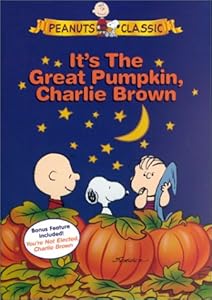
Cover of "It's the Great Pumpkin, Charlie...
(For those who receive these posts by email, this essay contains a video, which can only be viewed on the blog’s website, www.wheelchairkamikaze.com)

In October, 1966, one of my all-time favorite TV shows, the Halloween classic “It’s the Great Pumpkin, Charlie Brown”, was first shown on American TV. Featuring Charlie Brown, Lucy, Linus, Snoopy, and the rest of the Peanuts gang, the program’s storyline revolves around Linus’s heartfelt belief that every Halloween a legendary character known as The Great Pumpkin rises out of a pumpkin patch to fly through the air delivering toys to all the world’s children.

I was three years old when the show first aired, and my mom was so taken with it that for several years after, much to my delight, some shiny new toys would appear in my bedroom every Halloween, delivered by The Great Pumpkin. They’d always be there when I returned home from trick-or-treating in our apartment building, going floor by floor in my costume, knocking on doors and collecting goodies in my trick-or-treat bag. The thrill of trick-or-treating and then finding new toys in my room made Halloween one heck of a holiday for the little me. Lots of sugar and brand-new toys, what kid could ask for more?

One part of “It’s the Great Pumpkin” has the Peanuts gang out trick-or-treating, going house to house collecting goodies from their neighbors. That is, most of the kids receive goodies; our hapless hero Charlie Brown is always tricked rather than treated, like so:


Yep, when the other kids delightedly look in their bags and announce the candy goodies they’ve received, poor Charlie reaches into his and displays his joyless bounty, glumly stating, time after time, “I got a rock.” This heartbreaking little scenario sums up life for poor Charlie. Despite being a kind and gentle soul, more often than not, when the fates hand out their tricks and treats, Charlie Brown almost always gets stuck with a rock.

At the time of my diagnosis, Charlie’s lament, “I got a rock”, immediately sprang to mind. Just when things finally seemed to be coming together, when the trajectory of my life was in a long anticipated ascendancy, the very foundations of my existence were torn asunder by a big demyelinated lesion at the base of my brainstem, a great big rock thunking down right in the middle of life’s goodie bag. I’m sure everybody else who’s ever received such a diagnosis knows the feeling all too well. That damned stone was so heavy that it knocked me off balance even before the disease itself would upset my physical equilibrium, and its unruly weight grows ever more difficult to wrestle with as the disease progresses with the passage of time. For sure, I got a rock, as has everybody else stricken with a chronic disabling disease.

As I became more disabled and forced to the sidelines, I watched, slightly dumbfounded, as the rest of the world simply went on without me, never even skipping a beat. Certainly, my illness has rocked (pun intended) the lives of those closest to me, but outside of that small circle, it’s almost as if I simply went “poof”. I don’t begrudge my former coworkers and acquaintances their successes, and I’m truly saddened to hear when one has met with misfortune, but the acute awareness of my absence from these goings-on is something I’m not sure I’ll ever get used to. I’m now stuck on the outside looking in, constantly grappling with a great big rock that somehow landed in my goodie bag, while most everyone around me continues collecting treats, even if those treats often go unrecognized.

MS itself has definite geologic properties. Certainly, my weak and spastic limbs have become as if made of stone, uncooperative ballast that makes accomplishing previously simple tasks maddeningly impossible. The overwhelming fatigue that has become my constant companion has me feeling as if I’m playing the role of Sisyphus, a character forced in Greek mythology to forever roll an immense boulder up a hill, only to watch it roll back down again, over and over again. Intellectually, I always understood that tale to be one of perpetual frustration, but now, physically, I’ve come to fully empathize with the exhaustion that must’ve plagued old Sisyphus. He got a rock, too, quite literally, only he was a right bastard, cruel and deceitful, and his fate was justice meted out by the gods. I certainly was never anybody’s idea of an angel, but I’m pretty sure the heft of the rock I’m lugging around far outweighs whatever transgressions I might have committed.

Yes, I got a rock. Although this stone is a heavy burden, I try to keep in mind that getting stuck with a rock need not be a purely terrible thing. Surely, having a rock can even sometimes come in handy. They’re good for throwing at people you can’t stand, for instance those who say things like “but you look so good” or “I have MS but MS doesn’t have me”, or to stone some of the self-righteous jackasses who with distressing regularity have “MD” after their names and the insensitive clods that often tend to them. It's also fun to lazily skip stones over the surface of lakes and ponds, a mental metaphor I use to remind myself that I actually never really liked working, and being forced to “retire” has allowed me to pursue interests and cultivate talents that might otherwise have forever been neglected.

Remember too that the pyramids of Egypt are made of stone, as is the Cathedral Notre Dame, and Michelangelo’s David. The rock that has so disrupted my goodie bag has led me to meet many fine people and make friends with folks I otherwise would have never gotten to know. It’s made me re-examine my priorities, bringing into crystal-clear focus the precious little in life that is truly important. That damned rock has given me an understanding of how downright miniscule were so many of the trivialities that I used to consider problems, slight bumps in the road that I could neurotically conjure into mountainous obstacles to endlessly fret over. It has also inspired me to write words that have, much to my astonishment, been read by so many people in so many places, and perhaps, if even in just the smallest way, somehow helped some of them.

The Great Pumpkin hasn’t left toys in my room for about four decades, but that’s okay, I’m grateful that I was ever on his list. Charlie Brown might have only found rocks in his Halloween bag, but he was the hero of the Peanuts stories, not the kids who got the candy. Though he had to suffer a beagle who liked to make believe he was a World War I flying ace, a best friend to couldn’t be without a security blanket, and the indignity of often being called a blockhead, in the end Charlie’s simple humanity always seemed to save the day.

Would I give back the rock that was forced upon me, despite the insights and understanding it has led me to realize? You better believe it, and faster than you can say “pumpkin patch”. Being sick and getting sicker sucks, but I have no choice in the matter. I do, though, have a choice in what I do with my rock. I can let it crush me beneath it, or I can at least try to reverse places, to stand on top of it and take advantage of the view. Given the polarity of these two alternatives, as long as my life still has life and is not merely an existence, there’s really no choice at all. And who knows, maybe one of these days I’ll find that some fine chocolate has displaced that rock. It may be the longest of longshots, but stranger things have happened. After all, I’m the only real life person I know who got presents from The Great Pumpkin himself.

Thanks, mom.

Enhanced by Zemanta

Saturday, December 19, 2009

Moments of Clarity

The Storm is Coming

Image by innoxiuss via Flickr

Receiving a diagnosis of MS, or any serious illness, is a reality shattering event. There you are, going about the business of day-to-day life often as if on autopilot, when a huge hairy beast steps into your path, grabs you by the ankles, and drags you kicking and screaming into some strange new dimension. Suddenly, the world is a different place, everything that you took for granted now imperiled, your expectations for the future warped beyond recognition. What once may have seemed quite orderly has now fallen victim to chaos, and however composed one might appear on the outside, on the inside pandemonium has gained a foothold.

Even after many years of dealing with chronic illness, the chasm between what was expected and what has been received can be tremendously disorienting. When dealing with a progressively disabling illness like MS, reality is a moving target. It seems that just when you acclimate to your current condition, some new symptom or event crops up to tear apart even that impermanent reality. The human mind craves at least a minimal amount of order, but in the life of a chronically ill patient, disorder often has the day.

Lately I've been awash in a surplus of muddle and inner tension. The relentless progression of my MS, my dissatisfaction with the results of my cataract surgeries (which I'd had such high hopes for), and a bunch of other nagging health issues have combined to turn the universe into an unfriendly swirl of doubt and confusion. The coming of another holiday season, which starkly marks just how far my disease has progressed compared to holidays past, has also taken its toll. What is this treacherous path that I've been forced to follow? Is there some purpose that can be divined from it? And can this path possibly lead to a destination less ugly than the one I anticipate?

As threatening skies have gathered, I've managed to find some solace by taking shelter in a moment I experienced many years ago, a fleeting instant of understanding, a flash of insight that was gone before I could grasp it, the momentary comprehension that there are indeed patterns and reason and logic that lie just beyond the abilities of our puny, inadequate brains to realize.

I think I've experienced such a moment only once.

In late November, 1993, I was driving back from Key West to Miami, after spending a deliciously debauched but life-affirming weekend at the southernmost town in the United States, in the company of my extremely difficult but very attractive girlfriend. Back then Key West still had the vestigial feel of the Bohemian frontier town it once was, a feel which I understand is tragically now gone. I drove in the approaching dusk of one of those perfect tropical winter afternoons, the sky an endless blue, the balmy air tender as a gentle peck on the cheek. The convertible top of my little red sports car was down, its engine singing its satisfying throaty growl, King Pleasure's "Moody's Mood for Love" pouring from the speakers which lay embedded in the car's head rests, cleverly placed there so the music could be heard above the noise of the open road.

The late afternoon sun infused everything with a glowing pink and gold, and the road we followed was on one of the smaller islands that make up the Florida Keys, just a little spit of land less than a half-mile across, the Gulf of Mexico a few hundred yards to my left and the Atlantic Ocean the same distance to my right. The air whipping around us tasted like the ocean, and with one hand on the steering wheel, and the other feeling the vibrations of the motor through the stick shift, all of my senses were full.

I started to say something to the girl, and glanced over at her sitting to my right. Though she wore big dark sunglasses, I knew in an instant she was dozing, her head cocked gently to one side, her long strawberry hair playing with the wind. In the amber warmth of the setting sun, the sight of her, set in such perfect repose, stirred some secret part of my soul.

I took a breath, and quite suddenly everything stopped. The music and the sound of car and the road around me fell silent, I didn't exhale, I couldn't exhale, the girl and her tousled hair and the car and the sky and the world around us frozen for a pregnant instant. In that momentary pause, I flashed upon the unexpected understanding that I might have a chance at figuring it all out, that there could be significance and purpose to the teeming chaos that makes up a life, that the path upon which I tread might actually have some meaning.

And then it was gone, everything set back in motion. King Pleasure sang another note, my heart registered a beat, the girl stirred, and the march of life continued once again, just beyond the reach of comprehension. I exhaled.

Well, the car was sold about a year later, and the girl and I didn't last half that long. I’ve heard that Key West has since succumbed to the inevitable rot of commercialism, and is no longer the wonderfully strange little place I so loved back then. But for one single transcendent moment, all of these elements came together in a way that still keeps me pondering, in a tableau forever imprinted in my minds eye. In times of sadness, or trouble, or remorse, or confusion, I often retreat to that moment, and somehow find comfort in the wisp of insight into the wholeness of being that it provided.

Zen Buddhists refer to these brief moments of understanding as kensho. They call a deeper, more lasting enlightenment satori. Whatever its name, I'm grateful to have experienced my moment, as its impact has served me as an anchor through troubled times. Whenever the burden seems too great, the road too twisted, when I start getting lost in abstractions like "fair" and "not fair", I can slip back into that moment, and though I can't re-create the experience, the simple knowledge of it and the sense that there are indeed unknowable patterns within all of the seeming randomness grants me at least a few measures of serenity.

I guess some would call it faith...

Reblog this post [with Zemanta]